Frankly by Nicola Sturgeon
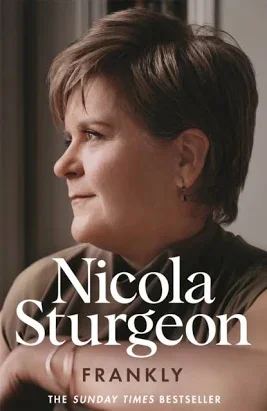
Frankly strikes a fine balance between boasting and vulnerability, so it’s quite the extreme angles. There are many examples of strong, confident moves, and as many admissions of mistakes. I still admire Nicola Sturgeon and came away with a far deeper understanding of Scottish politics and its history.
Through this, I understood why she became a member of the SNP rather than Labour, and was reminded that Scotland was not always the Tory-free nation it became. I hadn't known that the SNP helped Thatcher into power by voting no confidence against the Labour PM - a sobering fact. The book also filled in gaps about the referendum, including that the No campaign was internally known as Project Fear, a name that was leaked and ended up helping the Yes cause.
It doesn't matter how Scotland votes, as the sheer size of England's electorate means Scotland can still end up governed by a party it didn't vote for. It's a simple but powerful argument for why so many Scots see independence not as nationalism, but as democracy.
I enjoyed reading about the strong relationships Sturgeon built with other small-nation leaders, particularly with Martin McGuinness in Northern Ireland, as well as in Wales and the Republic of Ireland. (I’m looking forward to reading Jacinda Ahern’s book for the same reason).
However, on Cameron, Sturgeon writes that, whatever she thought of him at the time, he far exceeded the competence displayed by any of his successors, and that, given some of the characters who followed, she would later feel quite nostalgic about their interactions. How times have changed.
I did not know about Alex Ferguson's habit of quietly sending cheques to charities in need in Govan. Ferguson is the man who put Govan on the map for me.
Also didn’t know about John Knox, a 16th-century Scottish reformer who believed female rulers were unnatural and against God's will. His statue still stands in Edinburgh, where, in 1999, the Queen came to celebrate the first Scottish Parliament since 1707. That the Queen was celebrating a Parliament that was 37% women is a quietly brilliant piece of irony.
It's Time
The 2007 SNP election slogan. Simple, confident, and perfectly pitched.
The scrapping of prescription charges in Scotland is cited as one of the SNP's landmark achievements. For me, it's also one of the sanest arguments I know for Universal Basic Income: when you remove a barrier to accessing something essential, people's lives improve. It really is that simple.
Negative campaigns rarely win elections
As someone who wants to hear what politicians plan to do rather than what their competitors don't do, this is music to my ears. However, I wish it were still true, given the last decade in English politics.
It’s good to know that learning about inequality, the miners' strike, and her electrician father being on strike motivated the teenage Sturgeon to get into politics.
Unsurprisingly, the BBC comes out badly; its bias, London-centricity, and ignorance of Scotland, particularly during the referendum, are addressed head-on. And I know none of this has abated.
The treatment she endured from the press, from peers and from others, much of it rooted in sexism, is sadly unsurprising. It is that, more than anything, that makes this book a deterrent for me.
But I know that for much younger women, it will be the absolute motivation. Let’s hope so.